<?xml version="1.0" encoding="utf-8"?><feed xmlns="http://www.w3.org/2005/Atom" ><generator uri="https://jekyllrb.com/" version="4.2.2">Jekyll</generator><link href="https://destraynor.com/feed.xml" rel="self" type="application/atom+xml" /><link href="https://destraynor.com/" rel="alternate" type="text/html" /><updated>2026-07-21T14:24:55+00:00</updated><id>https://destraynor.com/feed.xml</id><title type="html">Des Traynor</title><subtitle>The homepage of Des Traynor</subtitle><entry><title type="html">The purpose of a system is what it does</title><link href="https://destraynor.com/writing/the-purpose-of-a-system-is-what-it-does/" rel="alternate" type="text/html" title="The purpose of a system is what it does" /><published>2025-03-08T00:00:00+00:00</published><updated>2025-03-08T00:00:00+00:00</updated><id>https://destraynor.com/writing/the-purpose-of-a-system-is-what-it-does</id><content type="html" xml:base="https://destraynor.com/writing/the-purpose-of-a-system-is-what-it-does/"><![CDATA[<p>When you’re building, running, or ultimately accountable for any mature system anywhere, the first thing you should understand that is that the purpose of the system is what it does.</p>

<p>The nature of working in a startup is that most business functions are either non-existent or broken and your job (regardless of when you join, honestly) is to help get them working well. Even the founders of the best companies I know, as in the $10B+ ones, will admit that whole chunks of the company are works in progress held together with duct tape at best, and blu tack at worst.</p>

<p>The job as an early hire in any function is to make it work well, and the evaluation of whether you did that will be simply: <strong>did that happen</strong>? Your intentions don’t matter. Your excuses don’t matter. Not to be all James Heftfield, but <em>nothing else matters</em>. The purpose of a system is what it does.</p>

<p>I recently saw a ex-Sonos engineer quip something to the effect of “<i>please hire me, I worked on the team who focussing on making our product demonstrably worse, year after year, and got my CEO fired</i>”. <a href="https://www.wsj.com/tech/sonos-speakers-app-ceo-24250f2c?mod=e2fb"> He was joking, but he wasn’t joking</a>. The CEO ultimately lost his job. Somewhere, at some meeting the Sonos leadership agreed that they should task R&amp;D with relentlessly rolling out unwanted upgrades, with increasingly larger footprints until one day the product just got too shit for everyone. Of course it wasn’t said like that, I bet the slides were slick as shit, but if you looked at it objectively from the outside in and give no benefit of the doubt, that is exactly what you’d conclude.</p>

<p>It takes a while for this to sink in, and your first reaction is always to lead with the counter-argument. I know it seems like this app has just gotten buggier but <i>that’s not what they’re trying to do</i>. I know it seems like we’re producing features no one uses but <i>that’s not what we’re trying to do</i>. I know that it seems like we’re just adding headcount here with zero impact but that’s <i>not what we’re trying to do</i>. But the purpose of a system is <strong>what it does, not what it’s trying to do.</strong> And if you evaluate the world around you like that, you’ll come to clarity quicker.</p>

<p>Bad shit happens in companies, all the time. And at every point you need to be hard enough on yourself to ask “Am I <em>sure</em> I haven’t actually designed a system that just does this?” and slightly more abstract “maybe locally the system I designed is fine but is it actually deeply integrated with a larger system, and the result of which is broken”, and you realise that’s what it is, and for a few hot seconds you might feel some personal relief. But the system is still broken because of what it does.</p>]]></content><author><name></name></author><summary type="html"><![CDATA[When you’re building, running, or ultimately accountable for any mature system anywhere, the first thing you should understand that is that the purpose of the system is what it does.]]></summary></entry><entry><title type="html">All this loneliness and population decline doesn’t bode well</title><link href="https://destraynor.com/writing/this-doesnt-bode-well/" rel="alternate" type="text/html" title="All this loneliness and population decline doesn’t bode well" /><published>2025-02-17T00:00:00+00:00</published><updated>2025-02-17T00:00:00+00:00</updated><id>https://destraynor.com/writing/this-doesnt-bode-well</id><content type="html" xml:base="https://destraynor.com/writing/this-doesnt-bode-well/"><![CDATA[<p>This is my first link roundup post, I'll do these by topic rather than time.</p>

<p> Some days you get to the bottom of your RSS queue, and it has been some <i>grim</i> reading. This was one of those days.</p>

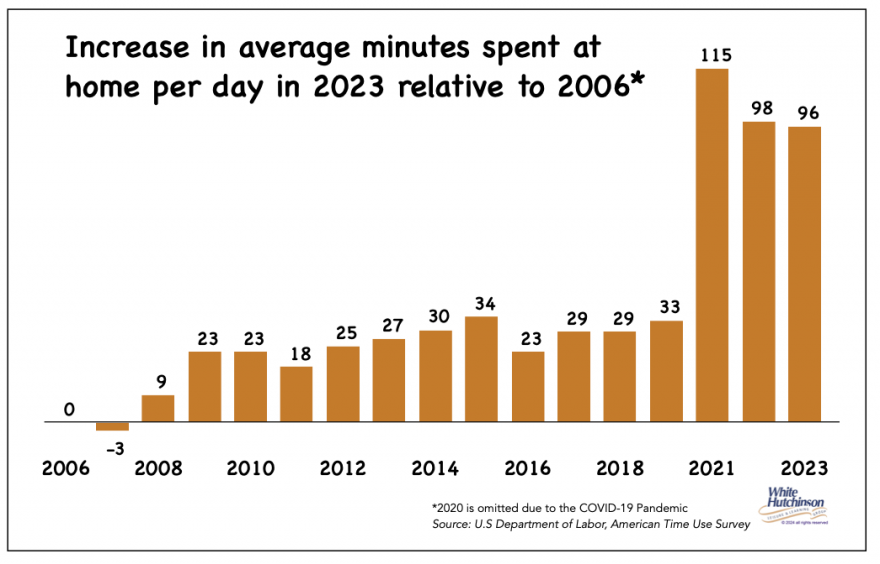
<p>There is an <a href="https://www.theatlantic.com/magazine/archive/2025/02/american-loneliness-personality-politics/681091/">epidemic of loneliness</a>. People spend far too much time at home.</p>

<figure>
  <img src="https://www.whitehutchinson.com/images/2024/20240915img15w440h282.png" alt="Graph on loneliness trends" />
  <figcaption>The 2024 numbers are also grim. This isn't good.</figcaption>
</figure>

<p>I spent my youth in a mix of work, pubs, restaurants, cinemas, gyms, arcades, etc. Today, that has become Doordash, Netflix, Peloton, woring-from-home, and online gaming.</p>

<p>How is anyone gonna meet anyone?</p>

<figure>
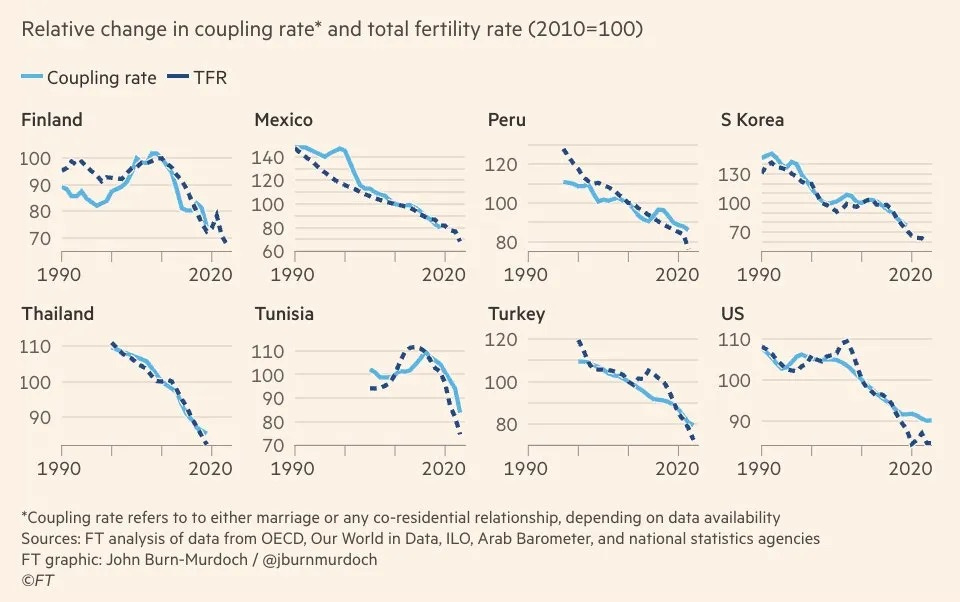
  <img src="/img/writing/essays/bodewell/relationships.jpg" alt="Relationships in the digital age" />
  <figcaption>Not exactly a shocking finding, but still power to see</figcaption>
</figure>

<p>Everyone has the apps, <a href="https://archive.is/dLghI">no one has the companions</a>. Far fewer people are now in relationships, and as a result, far fewer children are being born. Grim.</p>

<p>A related problem is that our fiercely celebrated Tinder-fueled casual sex culture means that, more than ever, sex doesn't lead to anything. <a href="http://thefp.com/p/loveless-sex-is-not-empowering">This is bad, but especially bad for women</a>. To actually keep the population headed in the right direction, we need to get out of our houses and go <i>make love</i>—figuratively and literally.</p>

<p>Even if that was happening, <a href="https://papers.ssrn.com/sol3/papers.cfm?abstract_id=5046571&amp;utm_source=substack&amp;utm_medium=email">the housing crisis is a compounding factor in the fertility crisis</a>.</p>

<p>In the event we fix all this and start having kids, it's important that:</p>
<ol>
    <li><a href="https://archive.is/3Qxu2">They take more risks</a>—kids are anti-fragile.</li>
    <li>We are <a href="https://www.educationprogress.org/p/schools-should-pursue-excellence?ref=thediff.co">ambitious with their education</a>.</li>
</ol>

<p>That's all for this round. If you've any interesting links or comments, send them to <a href="http://x.com/destraynor">@destraynor</a>.</p>]]></content><author><name></name></author><summary type="html"><![CDATA[This is my first link roundup post, I'll do these by topic rather than time.]]></summary></entry><entry><title type="html">The questions I’ll always ask in a product review</title><link href="https://destraynor.com/writing/questions-i-always-ask-in-product/" rel="alternate" type="text/html" title="The questions I’ll always ask in a product review" /><published>2025-02-09T00:00:00+00:00</published><updated>2025-02-09T00:00:00+00:00</updated><id>https://destraynor.com/writing/questions-I-always-ask-in-product</id><content type="html" xml:base="https://destraynor.com/writing/questions-i-always-ask-in-product/"><![CDATA[<p>I figured some of these might be useful to folks earlier in their career, certainly I wish I had them earlier, so here goes.</p>

<h3 id="big-picture-questions">Big picture questions</h3>
<ul>
  <li>Why did we build this? (Bad answer: because our competitor has it. Better: because we are losing deals to xyz who has a great version of it)</li>
  <li>Who, specifically, is it for? (Bad answer: Sales. Better: the person in charge of reporting on online revenue every week)</li>
  <li>What is the most ambitious version of this product? (here I’m testing for how well they’ve thought through the space)</li>
  <li>How does this version compare to it? (here I’m looking for smart scoping decisions, 80/20s etc.)</li>
  <li>What is the biggest assumption we’ve made that needs to be true for success? How have we tested that? (if there’s a bet we’re making, we should discuss it and see if we can ascertain things before going live)</li>
  <li>What’s the estimated impact here if this works out exactly as we planned? (numerically what will this feature do: drive sales, stop churn, change satisfaction, reduce support queries?)</li>
  <li>What does this look like in 2 years and what needs to prove true for us to continue resourcing it? (here I’m thinking about what does ‘done’ look like, or will this be a feature we’ll be building for the rest of our lives? e.g. reporting)</li>
</ul>

<h3 id="ai-questions">AI Questions</h3>
<ul>
  <li>What’s our confidence this feature will actually work for ~everyone in real world scenarios? What is needed to improve that?</li>
  <li>How has it performed thus far? What’s the worst outcome? What’s the most amazing thing we’ve seen? What’s the most common?</li>
  <li>How will we know if it’s not working live in production?</li>
  <li>What couldn’t we get working reliably, if anything?</li>
  <li>What guardrails have we built here?</li>
  <li>Do we have enough instrumentation to investigate issues in production?</li>
</ul>

<h3 id="customer-feedback">Customer Feedback</h3>
<ul>
  <li>What did customers say when you showed this to them?</li>
  <li>What was the energy/vibe like - one of relief (e.g., <em>“finally, guys!”</em>) or excitement (e.g., <em>“holy shit!”</em>)?</li>
  <li>What questions did customers ask? What wasn’t obvious? What concerns came up immediately?</li>
  <li>How long did it take for it to click with them? Was there an “aha” moment?</li>
  <li>Were the words we used familiar to them?</li>
  <li>How did this feature compare to their top 3 feature requests?</li>
  <li>Did they read the launch notes? Did they understand what we claimed to have built before they saw it?</li>
</ul>

<h3 id="product-management">Product Management</h3>
<ul>
  <li>What do you believe will be the #1 feature request in the days following launch? When is that shipping?</li>
  <li>What’s the most important thing we’re not shipping on day 1? (not necessarily same as above)</li>
  <li>What’s the least important thing that we are shipping?</li>
  <li>Does this juxtaposition make sense?</li>
</ul>

<h3 id="designui-questions">Design/UI Questions</h3>
<ul>
  <li>How long does it take for a user to see value here? Can we shorten it?</li>
  <li>What’s the breakdown of tool time vs task time? Have we tried to minimize each? (UI improvements, ‘quick start’ templates)</li>
  <li>How has the onboarding performed in testing? Are they engaging with it, or just clicking “next-next-next”?</li>
  <li>What’s the biggest barrier to adoption?</li>
</ul>

<h3 id="engineering">Engineering</h3>
<ul>
  <li>What are the known issues on launch day?</li>
  <li>Have we met our quality bar everywhere?</li>
  <li>Does this affect performance of any other part of the product?</li>
</ul>

<h3 id="analytics">Analytics</h3>
<ul>
  <li>What are our success metrics?</li>
  <li>What are our leading indicators?</li>
  <li>24 hours in, what can we tell?</li>
  <li>Are we running any tests on any part of this?</li>
  <li>When is our first review where we can learn meaningful insights?</li>
</ul>

<h3 id="customer-support">Customer Support</h3>
<ul>
  <li>Have we given support a heads up?</li>
  <li>Are we recording feedback on this feature specifically?</li>
</ul>

<h3 id="marketing">Marketing</h3>
<ul>
  <li>Will this feature be added to our marketing site, sales enablement, and docs?</li>
  <li>Did we consider adding this to our customer lifecycle marketing?</li>
  <li>Do we need reference customers for this feature?</li>
</ul>]]></content><author><name></name></author><summary type="html"><![CDATA[I figured some of these might be useful to folks earlier in their career, certainly I wish I had them earlier, so here goes.]]></summary></entry><entry><title type="html">The different types of people you work with</title><link href="https://destraynor.com/writing/5-the-different-types-of-people-you-work-with/" rel="alternate" type="text/html" title="The different types of people you work with" /><published>2025-01-24T00:00:00+00:00</published><updated>2025-01-24T00:00:00+00:00</updated><id>https://destraynor.com/writing/5-the-different-types-of-people-you-work-with</id><content type="html" xml:base="https://destraynor.com/writing/5-the-different-types-of-people-you-work-with/"><![CDATA[<p>I’m always reminded how much I trust someone when I’m emailing them with a request. I pay attention to my mind right after I click send. Over 15 years of working with a broad spectrum of folks—junior to senior, energetic to passive, people who suck the life out of me, and people who epitomise <a href="https://fullfocus.co/batteries-included/">batteries included</a>—I’ve bucketed them into five types.</p>

<h2>Forward &amp; Archive</h2>
<p>You know you’re working with this type of person when a problem lands on your desk, and you don’t even bother with the details. You don’t think about how to solve it because you know exactly who will—and they’ll do it better than your half-baked idea. So you just forward it, add a couple of words of thanks, and move on. That’s a Forward &amp; Archive type of person. You feel bulletproof working alongside people like this.</p>

<h2>Send &amp; Archive</h2>
<p>You’ve found a problem, dug into the weeds, and identified a solution that needs action. You know exactly who to trust with it, so you write it up and send it over. You’re absolutely certain they’ll get it done—promptly, to a high standard, and without cutting corners. No need for follow-up; it’s done. In your mind, the issue is already resolved, and you’re free to move on. That’s a Send &amp; Archive type of person.</p>

<h2>Send &amp; Verify</h2>
<p>You send the task over, and you know this person will not forget. However, the risk is they’ll accept some internal barriers, allow limitations, or tweak parts of the ask to make it easier to complete. Because of this, you need to stay close to ensure no dilution of your original intent. The changes they make are often well-intended—to facilitate speed or avoid obstacles—so you sympathise, but you still need to be in the loop. This is a Send &amp; Verify type of person; you set a reminder to follow up.</p>

<h2>Send &amp; Request Updates</h2>
<p>You don’t doubt this person can do what you’re asking, but you have open questions about their other priorities, focus, work rate, or diligence. Ultimately, you’re not yet convinced of their process for getting important stuff done. So you set a schedule of follow-ups, whether through weekly syncs or async updates, to ensure progress is substantial and the scope is maintained.</p>

<h2>Send &amp; Intervene So Much You May As Well Do It Yourself</h2>
<p>It’s tempting to put all the blame on the recipient here, but this one is actually on you for a few reasons. If they’re just incompetent, the question becomes: “mate, why are you even asking this person you don’t trust at all to do this?” You should probably figure that one out. More often, though, you do trust them, but you don’t really know what you want yet. If you can’t accurately describe what you’re after, the temptation is to give broad strokes and then stick your beak in every few days with new ideas. In practice, you’re trying to request something you haven’t yet figured out. Sometimes the best way out is to solve it yourself the first time.</p>

<p>And that’s it, I try my best to be #1 and #2 for those around me, I know I occasionally sadly dip into the lower levels, especially in areas I don’t understand or don’t feel comfortable in, but I’m working on it. And you’re probably the same :)</p>]]></content><author><name></name></author><summary type="html"><![CDATA[I’m always reminded how much I trust someone when I’m emailing them with a request. I pay attention to my mind right after I click send. Over 15 years of working with a broad spectrum of folks—junior to senior, energetic to passive, people who suck the life out of me, and people who epitomise batteries included—I’ve bucketed them into five types.]]></summary></entry><entry><title type="html">Just Run</title><link href="https://destraynor.com/writing/just-run/" rel="alternate" type="text/html" title="Just Run" /><published>2021-03-27T00:00:00+00:00</published><updated>2021-03-27T00:00:00+00:00</updated><id>https://destraynor.com/writing/just-run</id><content type="html" xml:base="https://destraynor.com/writing/just-run/"><![CDATA[<h2>2017</h2>
<p><span style="font-variant: small-caps"> The Phoenix Park, Dublin</span></p>

<p>“<i>My secret?</i>” The guy looked offended.  I was actually trying to pay him a compliment. An aged face, a shrinking frame, and a mop of wild gray hair, I would have placed him at maybe 65 years old. He stepped closer to me, like corona close, and patted me on the shoulder condescendingly as if he’d just beaten me in a game of 5aside. He leaned in further and said with a hint of anger: “<i>Just Fucking Run</i>”.</p>

<p>I was 36, in horrific shape, and blown away by this old man who ran more, ran further, ran faster, and honestly looked better doing it all too. I don’t know what I expected to hear when I asked about his secret, but I know I was definitely still in the mode of searching for one-click-answers. Maybe he had the right shoes? Maybe it was some running gel? Maybe he had some ingredient in his diet. I guess I hoped he’d offer some little tweak that I could make to my near-permanently unhealthy lifestyle and with the pop a pill or the purchase of a shoe I’d be all fixed.</p>

<p>But, No. Just Fucking Run.</p>

<p>I set off to destroy my body, asking hips &amp; knees to carry weight they can’t carry and shoudn’t have been asked to, and the words kept coming to me. Was that all it was? I plodded my way through an unremarkable 5k. My running app Strava has algorithms to find any bit of good news in your run, maybe you did your 3rd best time for a specific tiny subset of a kilometre somewhere, maybe this was your 5th best time for a Tuesday at 2pm. When I eventually finished, Strava simply said “Run completed” Just about too.</p>

<h2>2019</h2>

<p>40lbs lighter. I had kept running. I was now able to post what would be considered premium mediocre 5k times. The knees, hips, and back didn’t like it, but they didn’t hate it too bad either. Progress. As I headed into the park I saw my nemesis for the first time in a while, quite a while actually.</p>

<p>“Injured?” I shouted across the road.</p>

<p>“Training for an ironman”</p>

<p>“I kept running!” I said with a hint of pride, hoping he’d notice my physical improvement.</p>

<p>“What?”</p>

<p>He looked at me confused and just ran off. For me our 2017 conversation was significant, for him it was a Tuesday. His words left an impression on me, I left nothing on him.</p>

<p>I saw him a few more times over the years since, always running, always looking fit. Then it stopped. Putting him closer to 70 now I hoped he had just taken up walking or golf. I kept running.</p>

<h2>2021</h2>

<p>I’m on kilometre 19 of a 21.1km run. My body is starting to struggle, zero preparation and I hadn’t ran this far in over a year, so this was a step up. I’m still running and still keeping my posture upright but my headphones are now dead, my breathing is haphazard, and I’m firmly into the “<em>how much longer, Jesus are these numbers actually moving at all?</em>” territory. A stitch starts to form but I try to ignore it away, that often works.</p>

<p><b><i>Whack</i></b></p>

<p>Someone slapped me on the back, hard. Not friendly, not please step out of my way. Hard. Hard enough to make me realise I was definitely not properly upright as my body lengthened in reaction. Before I can turn he’s already overtaken me. Unmistakably <em>him</em>.</p>

<p>“<i>Just run lad</i>” he says without turning around.</p>

<p>Ah so he <em>did</em> remember me. I’m momentarily flattered, but maybe he say that to all the runners?</p>

<p>I decided I needed to learn what the hell is going on here, because here’s a 70yr old outpacing a 40 yr old, looking fitter, faster and probably running further too. I accelerate, in spite of what my body is telling me. I get to maybe 5:10/km but there’s just nothing in the tank at this point, and I’m not even close to him. The gray blur quickly fades into the distance.</p>

<p>I don’t know who the fuck that guy is. But I like him.</p>]]></content><author><name></name></author><summary type="html"><![CDATA[2017 The Phoenix Park, Dublin]]></summary></entry><entry><title type="html">Don’t forget to launch</title><link href="https://destraynor.com/writing/dont-forget-to-launch/" rel="alternate" type="text/html" title="Don’t forget to launch" /><published>2020-12-23T00:00:00+00:00</published><updated>2020-12-23T00:00:00+00:00</updated><id>https://destraynor.com/writing/dont-forget-to-launch</id><content type="html" xml:base="https://destraynor.com/writing/dont-forget-to-launch/"><![CDATA[<p>If there’s one piece of advice I give most early-stage startups it’s simply that.</p>

<p>Don’t forget to launch.</p>

<p>I say it to every pre-launch startup I talk to, or who asks for my advice. As you’d guess it often comes across both weird and unnecessary. “<em>Des, this doesn’t sound like the type of value-add advice we need, I mean  who in their right mind has an idea, builds a team, raises a few million of venture capital, and then… forgets to launch?</em>”</p>

<p>And yet I keep saying it, and <em>still</em> so many keep forgetting.</p>

<p>When I say launch, I mean the real deal. No apologies, no private lists, no friends &amp; family launches, no <em>DM our founder and see if you can get an access code</em>, I mean “put it all out there, and watch what happens, learn, and be ready to react”.</p>

<p>I’ve watched about a dozen companies with great ideas, with plenty of funding, with strong teams, forget to launch. Forget is probably an unfair word here. What actually  happens is that there’s a long list of priorities and the big scary launch where you find out if the whole thing is worthwhile falls below the easy next task that doesn’t bite back. Do that enough and you have a big product, a good demo, some well-polished narrative, but no actual evidence that any of this will work. And the clock keeps ticking down.</p>

<p>In Intercom, we say Shipping is an act of confidence and humility. You need enough self-confidence and belief to put yourself out there, and then you need to be humble enough to accept you probably got lots of bits wrong along the way. Your product is a conversation with the market and launching is just the opening dialogue.</p>

<p>The real risks of indefinitely postponing launch are:</p>

<ol>
  <li>
    <p><strong>Your ideas hit the market before your product does.</strong> Other companies learn from what you share in your blog posts, or your teaser screenshots. I’ve seen companies ship great ideas that they found percolating in the private betas of the less confident startups still waiting for perfection.</p>
  </li>
  <li>
    <p><strong>You inspire the market, but that inspiration is perishable.</strong> Buzz has a shelf life, you can get everyone excited and ready to rock on your new project management app, calendar, to-do, but if they can’t use it for a few more months they move on.</p>
  </li>
  <li>
    <p><strong>It gets harder the longer you wait.</strong> There’s some type of vicious cycle here, where your fears &amp; expectations and ultimately your launch keeps growing which weirdly means the launch date seems to get further away the more you work. <a href="https://twitter.com/bokardo/status/598959253454336001?ref_src=twsrc%5Etfw">The next feature fallacy is real.</a></p>
  </li>
  <li>
    <p><strong>The chances of success are lower.</strong> Unless you know your area and your customers inside out, you will make some mistakes in the form of unnecessary or misguided features. The longer you wait, the more you’ll have. The more you have, the slower you’ll move. The slower you move the quicker you die.</p>
  </li>
  <li>
    <p><strong>Runway &amp; Energy are too low for launch.</strong> This one should be obvious, but again…launch is the starting line, not the finish line. If you intend to forge your way to product-market fit you should assume you’ll need to release 2-3 more significant versions of your product, you and your team will need the energy to do customer support,  the customer research calls, the long days the late nights fixing critical issues and launching “must-haves”. Doing all this on an empty tank will kill you. And similarly launching with 2-3 months of runway left puts you in a very very difficult position.</p>
  </li>
</ol>

<p>I understand the safety net of not launching, you can maintain your perceived status as a founder, your product can continue to evolve aspirationally until it becomes the “superset of all great feature ideas ever”, and most importantly you can continue to use the future to defend yourself from the present. You keep telling yourself, your investors, and your employees about how great things are <em>going to be</em> once you launch.</p>

<p>And yes, the fear is real, it is understandable. It’s okay to be terrified about putting the biggest work of your career out to the world to be criticized, questioned, and sadly, yes, dunk-tweeted by losers who’s only way to prop themselves up is to shit-post about other companies.</p>

<p>But just know that there are worse things in life than your ideas getting picked apart and criticized. You could, for example, piss away years of your life avoiding reality and refusing to launch. It is truly better to regret something you did than something you couldn’t do.</p>

<p>So that’s seven hundred words to say just four: <b>don’t forget to launch.</b></p>]]></content><author><name></name></author><summary type="html"><![CDATA[If there’s one piece of advice I give most early-stage startups it’s simply that.]]></summary></entry><entry><title type="html">A new homepage</title><link href="https://destraynor.com/writing/a-new-homepage/" rel="alternate" type="text/html" title="A new homepage" /><published>2020-07-01T00:00:00+00:00</published><updated>2020-07-01T00:00:00+00:00</updated><id>https://destraynor.com/writing/a-new-homepage</id><content type="html" xml:base="https://destraynor.com/writing/a-new-homepage/"><![CDATA[<p>Let’s try this again.</p>

<p>I suspect this is the longest postponed project of my life, if you don’t count my PhD. Except this one I actually finished, thanks to <a href="http://davidedwardbarrett.com">Mr. David Barrett</a>. I’ve long wanted to collect all the various work I’ve done online from blog posts to podcasts to presentations, and everything in between. I also wanted a place where I could write personal pieces that have nothing to do with tech whatsoever. So here we are.</p>

<p>It’s definitely a bit of a building site at the moment, some links don’t work, some pieces of the design will only really make sense as more content arrives. Ship to Learn is a core Intercom product principle, so that’s what you’re looking at here.</p>

<p>The sad realisation in constructing this site was how many links are now simply dead and as a result how much work leaves zero legacy. There are magazines I wrote articles for that no longer exist, the domains don’t resolve and the google searches don’t help. There are presentations I’ve given where the videos have disappeared as have the conference companies. So one thing that on my mind in constructing this was to not end up sitting on another flakey third party blogging engine who can change terms and conditions on a whim.</p>]]></content><author><name></name></author><summary type="html"><![CDATA[Let’s try this again.]]></summary></entry><entry><title type="html">She would be 80 today</title><link href="https://destraynor.com/writing/she-would-be-80-today/" rel="alternate" type="text/html" title="She would be 80 today" /><published>2019-02-13T00:00:00+00:00</published><updated>2019-02-13T00:00:00+00:00</updated><id>https://destraynor.com/writing/she-would-be-80-today</id><content type="html" xml:base="https://destraynor.com/writing/she-would-be-80-today/"><![CDATA[<p>Here’s some words you don’t ever want to hear: “It’s on her liver, now”.</p>

<p>That was when the last piece of hope left, and my heart sank, and my mind, body, and soul faded away. I don’t know if they’ve ever really recovered, but maybe you don’t recover. You just change.</p>

<p>I remember so much about my mother, that’s never been a problem. In many ways I never really left home, I was there with her every step of the way from when I was born through when I was 30 and starting Intercom through when she left us. She was always so supportive of everything I ever tried, I could have been truly woeful at something and she’d tell me to keep going. I could be clearly talented and she’d say “keep going”. No matter what <em class="text-subtle-emphasis">just keep going.</em></p>

<p>Two things that stuck with me that I’ll write about here because writing helps me get my head straight, and sometimes that’s exactly what I need. This won’t be a good piece, nor is it complete enough. But it’s a start.</p>

<p>Firstly she was <em>always</em> a parent. As I’ve grown up and witnessed how people parent their kids, and there’s 2 distinct ways I see. Some believe parenting is a skill you use when needed, when there are parenting moments where you must step up and teach the child what they did right or wrong. In those moments the child learns and you’ve done your job.</p>

<p>The alternative and the one outlined by Clay Christensen in “How will you measure your life”, is the one that resonates with me more. You’re <em>always</em> parenting, especially when you don’t want to be. Your child learns from every single thing you do. Every time you show patience, every time you show kindness, fear, anger, bitterness, resentment, jealousy, pride, compassion, you name it. You are always teaching your children, you can’t switch it on &amp; off.</p>

<p>That’s the mother that she was to me.</p>

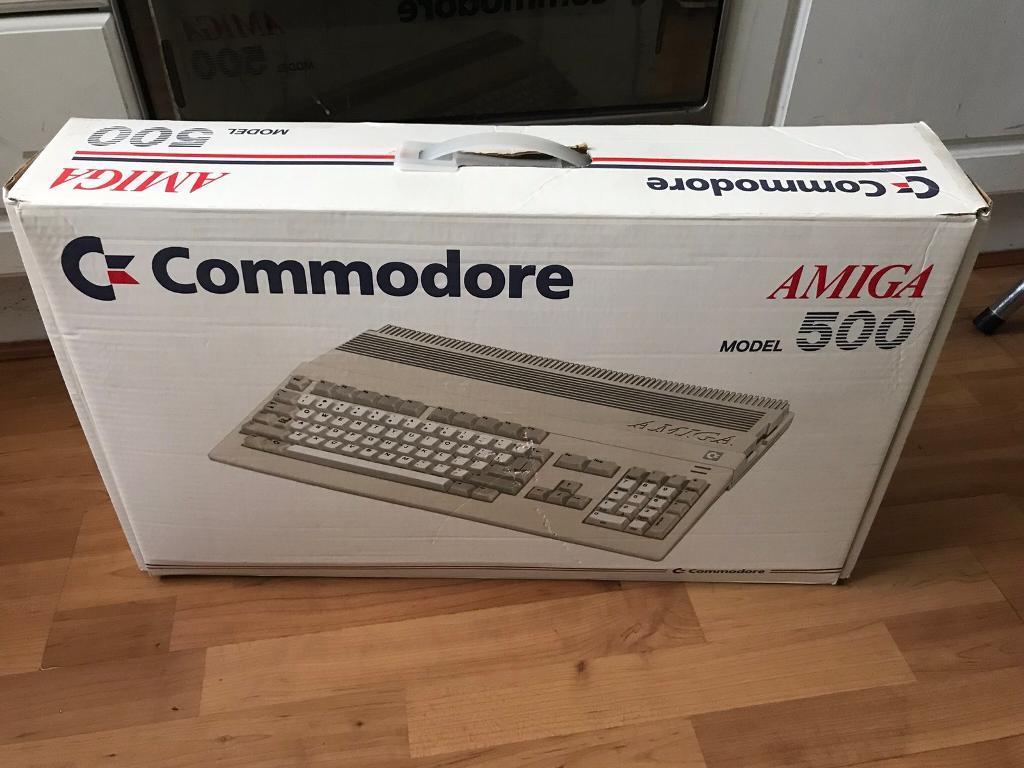
<p>Secondly, randomly, was the Amiga 500. Yes, you read that right. I’m the youngest of seven children and when I was 5 my Dad left the house (or was asked to leave to live with his new partner), and that left my Mam to look after me and 4 others. This was 1980s Dublin. Money was beyond tight and she had to look after 5 kids, 4 in school, with no job, and somehow make ends meet. And still, one March for my birthday, I got this…</p>

<p><img src="https://destraynor.com/img/writing/essays/she-would-have-been-80-today/amiga.jpg" alt="Amiga" /></p>

<p>Where the fuck did she get the money to get me an Amiga 500?</p>

<p>Seriously. I know I wanted it more than anything and I probably literally never shut up about it. But I think it was £700 Irish pounds. I just had to look up how to type £, that’s how far back we’re going. And because of that, I learned to use <a href="https://en.wikipedia.org/wiki/Workbench_(AmigaOS)">Amiga Workbench</a>, I learned <a href="https://en.wikipedia.org/wiki/AMOS_(programming_language)">AMOS</a>, I learned how to change memory contents while playing computer games using the incredible <a href="https://en.wikipedia.org/wiki/Action_Replay">Action Replay</a> and because of that (and the incredible support of a friend and his family) I realized I was good at computers. I got them. They seemed to understand me. And because of that I studied computer science and software engineering and because of that I met <a href="https://twitter.com/davebarrett">David Barrett</a> and because of that I started a blog (originally held on this very domain) and because of that I wrote about programming, design, and usability, and because of that met <a href="https://eoghanmccabe.com">Eoghan McCabe</a>, and we started an agency called Contrast and David joined and because of all that <a href="https://www.intercom.com">Intercom</a> got started in 2011. We used to day dream about the idea that Intercom could go on to be worth, <em>who knows,</em> maybe $50 million one day. <em>Maybe. Who knows.</em></p>

<p>And if it ever was I swore to myself, that I’d pay my Mam back for that Amiga 500 1,000 times over. And then after December 10th, 2012 3:10pm, it was no longer possible to pay her back at all, she was gone. But I’ll make it up to her, that I promise.</p>

<p>Today my mother Nancy Traynor should have turned 80 and today my <a href="https://www.instagram.com/p/BntweI9HAUV/">daughter</a> Nancy Traynor turns 5 months old. I’ll do my best to look after the latter until I see the former again.</p>

<p>I know, dear reader, this is probably a tough read for you. That’s actually true whether you have 0, 1, or 2 parents. All I can say is spend a lot of time with them if they’re still here. (And now a rant will follow…)</p>

<p>See that’s the one tip that gets missed in every single bullshit guru tweetstorm about how to bleed every last piece of productivity from every second you have to spare. Wake up at 5am, fast, cycle, spin, work, learn, read, tweet about reading, exercise, fast, are-you-reading-yet, sleep early in a cool dark room with a air purifier, read again, don’t forget to journal, do this until it’s time for brunch on Saturday!</p>

<p>But look around you, all these people will be gone one day, especially the ones who spent their whole lives looking after you, yes you. Think about that once in a while. Spend your time, love, energy, and emotion accordingly. Know this: <strong>inside every 80 year old is an 18 year old wondering what the fuck just happened.</strong> We’ll all get there.</p>

<p>Raymond Carver (also died of lung cancer), wrote this last piece (Late Fragment) from his deathbed: <em class="text-subtle-emphasis">“And did you get what you wanted from this life, even so? I did. And what did you want? To call myself beloved, to feel myself beloved on the earth.”</em> It’s good to think about that idea from time to time. What are you actually working toward?</p>

<p>So it’s taken me ~6 years to actually publish this, and let’s be honest, it’s certainly not because I took the time to write it well, right? Some personal pieces are just too hard to click publish on because your feelings keep evolving and you’re never sure it’s final because your life is still going and well there’s always better and more respectful ways to phrase things, but screw it, it’s done now. Happy birthday Mam, I love you, and I swear I’ll keep going ❤️</p>]]></content><author><name></name></author><summary type="html"><![CDATA[Here’s some words you don’t ever want to hear: “It’s on her liver, now”.]]></summary></entry></feed>